Magnificent Historic Château And Its Domain At The Gates Of The Perche Region
Illiers-Combray, Centre-Val de Loire, France
Price
€3,180,000
Property Type
Castle
City
Illiers-Combray
Region
Centre-Val de Loire
Overview
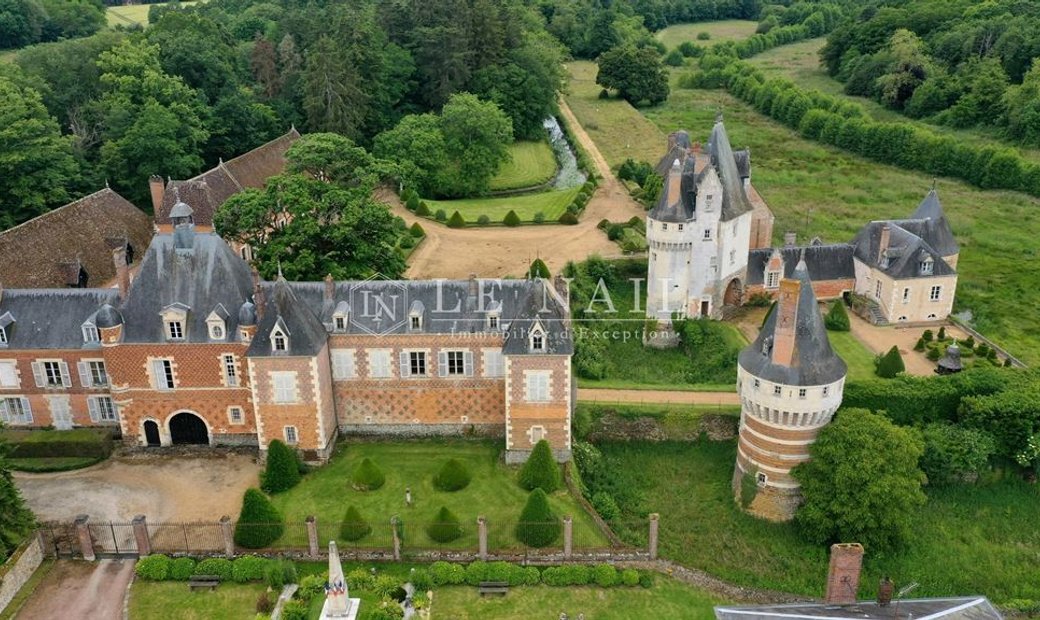
[hidden information] : Magnificent historic Château and its domain at the gates of the Perche region In the magnificent Perche region, barely an hour from Paris, in an intimate valley, you will discover this breathtaking historic ensemble that transports you back to its glorious past. This property draws visitors in with its magnetic aura. The Perche, a land renowned for its succession of gentle hills and remarkable forests of centuries-old beech and oak trees that offer bucolic, invigorating walks, has been designated a ‘Regional Nature Park’.
It’s also the land of manor houses, fine residences and the famous Percheron horses. This makes it a destination of choice for lovers of peace and nature. It’s within easy reach of the beautiful UNESCO-listed cathedral city of Chartres, and the Châteaux of Maintenon and Nogent le Rotrou, Two towns less than 5 minutes away offer all the necessary services, train stations, fast motorway access to Paris and tourist activities, as well as a magnificent golf course just a few minutes’ drive away.
There are five complementary architectural ensembles 1 - The ‘château’ closest to the village square, dating from the 16th and 17th centuries, with a second storey added in the 18th century. 2 - The 15th, 18th and 20th century châtelet. 3 - The 15th century tower. 4 - The Louis XVI pavilion known as the ‘Renaissance house’ and its tower known as ‘the bell’, 16th century, modified in the 17th and 18th centuries. 5 - The outbuildings, 16th century. Work on the facades and floors in the late 19th and early 20th centuries. Buildings 1 to 5 have a total surface area of 2,531 m² (0.5 acres) of which : Outbuildings including garages: 1,085 m² (1,085 sq ft) Habitable and convertible: 1446 m² (1,446 sq ft) The property is laid out around a formal garden, with the outline of the Châtelet to the north-east comprising the tower, the gallery, the keep, the corner tower and, with its moat and rectangular shape, the building known as the ‘Pavillon du bourg’ to the east, which faces the village and the main entrance after the gates.
To the south of the central garden are the outbuildings, comprising a large hall and garages. To the west is a beautiful pavilion with a Louis XVI façade, overlooking the beautiful views of the garden with its terraces, driveway, perrons, 18th century statues and white water canal. 1 - THE CHÂTEAU KNOWN AS LE PAVILLON DU BOURG This large building - closest to the village square and facing east-west comprises 2 separate units linked by a common central staircase. It is topped by a bell tower.
Constructed of white stone and orange bricks on a sandstone base. Slate roof. 1A - Part facing EAST / WEST with gable to the NORTH, surface area of 436 sqm Ground floor : Entrance hall, kitchen and bathroom, 3 reception rooms in a row with an open fireplace, a west-facing porch, a library. 1st floor : Clearance and corridor, bathroom with bath, electric hot water tank, sanitary facilities. 2 bedrooms, onewith a wash-hand basin, and the master bedroom (1900 ‘Indian’ wall hangings) with a fireplace, and its ‘toilet’ with a fireplace. 2nd floor under roof : 5 rooms, 2 flues, attic. Clearing and corridor, sanitary facilities, Vaulted cellars 1B - Part facing EAST / WEST with gable to the SOUTH, surface area of 297 sqm Ground floor : Fitted porch with exposed beams, storage cupboard, boiler room with sanitary facilities, entrance hall, small kitchen (with sink), large kitchen with exposed beams and large antique stove, staircase.
First floor (served by the communal staircase and the large kitchen staircase: hallway with corridor, bedroom, bathroom with toilet, large bedroom (with washbasin), small bedroom converted into a library (with toilet). Second floor (served by the communal staircase) : hallway with level corridor, large bedroom (with washbasin), bathroom, sanitary facilities, kitchen (with sink), small bedroom (with washbasin), attic room converted into a lounge/dining room and separated from the rest, small bedroom on landing (with washbasin). 2 - THE CHÂTELET known as ‘LE DONJON’ Covering an area of 263 sqm Built mainly of white stone for the châtelet with a grison base, and orange bricks bricks for the gallery and rotunda with stone surrounds. The 20th-century extension tries to blend in with the rest of the building, with its rendered facades and stone surrounds.
All the roofs are slate. Ground floor : guard room with fireplace and opening in the floor for access to the dungeon. Raised ground floor : Seigniorial chapel with ribbed vault, redesigned altar site, added stained glass windows.
The upper floors are accessed by a small spiral staircases, small bedroom, bedroom with fireplace and stairway leading to a small room in the basement, bathroom with sanitary facilities. 2nd floor : bedroom with fireplace, bathroom with sanitary facilities and exposed beams, small room with exposed beams, two covered walkways. 3rd floor : bedroom with fireplace, bathroom with sanitary facilities, small converted attic space Basement : dungeon accessible on the ground floor of one of the two circular [hidden information] the other tower, storeroom extending the cellar into a gallery accessible from the courtyard. The 15th century gallery One level over a vaulted cellar Situated on the raised ground floor, accessible from one of the towers of the châtelet, it leads to a room converted into a dining room, all over a vaulted cellar accessible from the courtyard. Restored in the 20th century with fireplace, stone benches, bookshelves and cupboards.
The 18th-century corner tower and its extension One level on a basement Rotunda with fireplace converted into a lounge leading to a room converted into a dining room. The 1980s extension has three levels, accessed via a porch and served by a stairway. Raised ground floor : hallway with corridor, sanitary facilities, kitchen with staircase First floor: landing with cupboard, bedroom, shower room with sanitary facilities Attic of the corner tower Basement : linen room boiler room 3 - THE 15th century SAINT FRANCOIS TOWER Constructed of white stone and orange bricks on a sandstone base.
Slate roof. 4 levels served by a spiral staircase : Raised ground floor : beamed room with fireplace First floor : room with fireplace, walkway Second floor : vaulted room Basement : vaulted room 4 - THE LOUIS XVI PAVILION KNOWN AS ‘LA MAISON RENAISSANCE’ AND ITS TOWER KNOWN AS ‘LA CLOCHE’ Surface area: 136 sqm. Flint and white stone construction for the Renaissance-style modelling on the courtyard side. Orange-coloured brick on the east gable and the north facade overlooking the meadow below, with a base of sandstone.
Flat terracotta tile roof. Ground floor: Dining room with fireplace, hallway, stairs to first floor, bathroom and shower, kitchen, large sitting room with fireplace. First floor: One bedroom and bathroom with sanitary facilities Areas suitable for conversion.
Ground floor: Store room with one ffireplace, staircase to attic. First floor: Large volume under roof frame. Basement : Storeroom and linen room, cellars, accessible from outside.
La Cloche’ tower, surface area 54 sqm. Orange brick and white stone construction. Slate roof in the shape of a truncated cone-shaped bell topped with a small dome.
Ground floor: One room with fireplace and internal staircase, accessed via the outside walkway from the pavilion. First floor: One room under the bell roof. Basement: Painter’s studio with One fireplace, accessible from the outside.
OUTBUILDINGS : Large bayonet-shaped building in two parts with a floor surface area of 540 sqm and a first floor of 545 sqm that could be converted. The building features brick architecture with traditional stone framing and an imposing flat terracotta tile roof, enhanced by large dormer windows, either in wood or in stone and brick, the whole offering a certain architectural homogeneity, in harmony with the castle: 1st part : Two outdoor sanitary units adjoining the building (water supply to be reviewed), Ground floor : Three closed garages used occasionally as reception rooms. An unobstructed bay gives access to the adjoining reception room.
First floor : One large room known as the ‘wood loft’ with large roof dormers under a boat hull-type roof frame. Miscellaneous Electrical wiring redone in the 1970s. A water point at the corner of the 1st garage. 2nd part : Ground floor : hallway + stairway leading to the ‘wood loft’ and the ‘grain loft’; access to a large room known as the ‘games room’ with a large fireplace, stable with two boxes and three stalls including stairway for direct access to the ‘hay loft’, a tack room, horse-drawn carriage shed with direct access to the stable, and ‘car’ access via the fourth garage. ‘car’ access via the 4th unenclosed garage.
The water tower : Massive flint construction with white stone surrounds, with a base of greywacke. The facade is adorned with a belt of carved stone, in the style of a dovecote. The roof is covered in flat terracotta tiles.
The building is cylindrical in shape, with one room per floor and four storeys. The tank at the top is fed by a pump that draws water from the pond at the foot of the building. The water tower (private) supplied all the buildings on the estate until the 1980s.
The watchtower, the well, the woodshed, the shed, the wash-house, the sheepfold. LAND : The gardens were completely redesigned at the end of the 19th century, creating a beautiful French-style ensemble. The estate covers 44 acres (22 ha 19 a 25 ca).
Cabinet LE NAIL – Centre - Eure et Loir – M. Ernesto SORIA : [hidden information] Ernesto SORIA, Individual company, registered in the Special Register of Commercial Agents, under the number [hidden information]. We invite you to visit our website Cabinet Le Nail to browse our latest listings or learn more about this property.
Réf.4447 : Sublime Château et domaine historique aux portes du Perche Dans la magnifique région du Perche, à environ une heure de Paris, on découvre dans une vallée intime cet ensemble historique époustouflant qui nous transporte dans son passé glorieux. Cette propriété appelle le visiteur à y pénétrer par son aura magnétique. Le Perche, une terre connue pour sa succession des douces collines et de remarquables fôrets de hêtres et chênes séculaires qui offrent des balades bucoliques et vivifiantes, bénéficie de l’appellation ”Parc Naturel Régional”.
C’est aussi le pays des manoirs, des belles demeures et des fameux chevaux percherons. Cela en fait une destination de choix pour les amateurs de calme et de nature. Elle se trouve à proximité de la belle ville Cathédrale classe Unesco de Chartres, des Châteaux de Maintenon et de Nogent le Rotrou, Deux villes situées à moins de 5 minutes qui offrent tous les services nécessaires, des gares ferroviaires, un accès autoroutier rapide vers Paris et des activités touristiques, ainsi qu’un magnifique terrain de golf à quelques minutes en voiture.
Nous pouvons distinguer 5 ensembles architecturaux complémentaires : 1 - Le « château » au plus près de la place du village, datant du XVIème et XVIIème, et rehaussé d’un étage au XVIIIème. 2 – Le châtelet XVème, XVIIIème, et XXème. 3 – La tour XVème. 4 – Le pavillon Louis XVI dit « maison Renaissance » et sa tour dite « la cloche », XVIème siècle, modifiée au XVIIème et XVIIIème siècle. 5 – Les communs, XVIème. Travaux de façades et planchers fin XIXème, début XXème. L’ensemble des bâtiments 1 à 5 ont une surface de 2531 m² dont : Communs y compris garages : 1085 m² Habitable et aménageable : 1446 m² La propriété s’organise autour d’un jardin à la française, avec au nord-est le contour du Châtelet comprenant la tour, la galerie, le donjon, la tour d’angle et, avec ses douves et sa forme rectangulaire, le bâtiment dit « Pavillon du bourg » à l’est, qui fait face au village et à l’entrée principale après les grilles.
Au sud du jardin central se trouvent les dépendances, composées d’une grande salle et de garages. A l’ouest se trouve un beau pavillon à façade Louis XVI, qui donne sur les belles vues du jardin avec terrasses, allée, perrons, statues du XVIIIe siècle et canal d’eaux vives. 1 - LE CHÂTEAU DIT LE PAVILLON DU BOURG Ce grand bâtiment - au plus près de la place du village et orientée est/ouest comporte 2 entités distinctes reliées par l’escalier central commun. Il est surmonté d’un clocheton au sommet de la couverture.
Construction de pierres blanches et briques orangées sur assise et soubassement en grison. Couverture en ardoise. Il comprend : 1A – Partie orientée EST / OUEST avec pignon au NORD surface de 436 m2 Rez de chaussée : Entrée, cuisine et sanitaires, 3 pièces de réception en enfilade avec une cheminée à feu ouvert, un perron à l’ouest, une bibliothèque. 1er étage : Dégagement et couloir, salle de bains avec baignoire, ballon eau chaude électrique, sanitaires. 2 chambres dont 1 avec lavabo, et la chambre principale (tentures « indiennes » 1900) avec une cheminée, et son « cabinet de toilette » avec une cheminée. 2ème étage sous toiture : 5 pièces, 2 conduits de fumées, grenier.
Dégagement et couloir, sanitaires. Caves voûtées 1B – Partie orientée EST / OUEST avec pignon SUD surface de 297 m² Rez-de-Chaussée : Porche aménagé avec poutres apparentes, placard débarras, chaufferie sanitaires, sas d’entrée, petite cuisine (avec évier), grande cuisine avec poutres apparentes et grand fourneau ancien, escalier. Premier étage (desservi par l’escalier commun et l’escalier grande cuisine) : dégagement avec couloir, chambre, salle de bains avec sanitaires, grande chambre (avec lavabo), petite chambre aménagée en bibliothèque (avec cabinet de toilette) Deuxième étage (desservi par l’escalier commun) : dégagement avec couloir à niveaux, grande chambre (avec cabinet de toilette), salle de bains, sanitaires, cuisine (avec évier), petite chambre (avec lavabo), pièce sous combles aménagée en salon/salle à manger et séparée du reste, petite chambre sur palier (avec cabinet de toilette) 2 – LE CHÂTELET dit « LE DONJON » Surface de 263m² Construction de pierres blanches principalement pour le châtelet avec un soubassement en grison, et de briques orangées pour la galerie et la rotonde avec encadrements de pierres.
L’extension du XXème essaye de se fondre dans l’ensemble avec ses façades enduites avec encadrements de pierres. L’ensemble des couvertures est en ardoises. Rez-de-Chaussée : Salle de garde avec cheminée et ouverture au sol pour accès à l’oubliette.
Rez-de-Chaussée surélevé : Chapelle seigneuriale sous voûte d’ogives, emplacement d’autel remanié, vitraux rapportés. Les étages sont desservis par un petit escalier à vis. Petite chambre, chambre avec cheminée et escalier desservant une petite pièce en sous-sol, salle de bain avec sanitaires. 2ème étage : Chambre avec cheminée, salle de bain avec sanitaires et poutres apparentes, petite pièce avec poutres apparentes, deux chemins de rondes. 3ème étage : Chambre avec cheminée, salle de bain avec sanitaires, petit comble aménagé.
Sous-sol : Oubliette accessible en rez-de-chaussée de l’une des deux tours circulaires, dans l’autre tour, réduit prolongeant la cave en galerie accessible depuis la cour. La galerie du XVème siècle Un niveau sur cave voûtée Située en rez-de-chaussée surélevé, accessible depuis l’une des tours du châtelet, dessert une pièce aménagée en salle à manger, le tout sur cave voûtée accessible par la cour. Restaurée au XXème siècle avec cheminée, bancs de pierre, étagères de bibliothèque, placards.
La tour d’angle du XVIIIème siècle et son prolongement Un niveau sur soubassement : Rotonde avec cheminée rapportée aménagée en salon desservie par la pièce aménagée en salle à manger. L’extension des années 1980 sur trois niveaux accessible par perron et desservie par escalier. Rez-de-chaussée surélevé : Vestibule avec dégagement, sanitaires, cuisine escalier.
Premier étage : Palier avec placard, chambre, salle de douche avec sanitaires. Combles de la tour d’angle. Sous-sol : Lingerie chaufferie. 3 – LA TOUR SAINT FRANCOIS du XVème siècle Construction de pierres blanches et de briques orangées sur un soubassement en grison.
Couverture en ardoises. 4 niveaux desservis par un escalier à vis : Rez-de-Chaussée surélevé : pièce sous poutres apparentes avec cheminée. Premier étage : pièce avec cheminée, chemin de rondes. Deuxième étage : pièce voûtée.
Sous-sol : pièce voûtée. 4 – LE PAVILLON LOUIS XVI DIT « LA MAISON RENAISSANCE » ET SA TOUR DITE « LA CLOCHE » Surface de 136m² Construction de silex et de pierres blanches pour les modénatures de style Renaissance côté cour d’honneur. Construction de briques orangées pour le pignon Est et la façade Nord sur la prairie en contrebas, avec un soubassement de grison. Couverture de tuiles plates en terre cuite.
Rez de chaussée : Salle à manger avec cheminée, dégagement, escalier accès étage, sanitaires et douche, cuisine, grand salon avec cheminée. Premier étage : Une chambre et une salle de bains avec sanitaires. Parties aménageables, Rez de chaussée: Réserve avec une cheminée, escalier accès combles.
Etage: Grand volume sous charpente. Sous-sol : Dégagement et lingerie, caves, accessibles par l’extérieur. DEPENDANCES : Un grand bâtiment en baïonnette en deux parties d’une surface de 540 m² avec un étage de 545 m² aménageable.
L’ensemble reprend l’architecture de briques avec encadrement traditionnel en pierre avec une imposante couverture de tuiles plates en terre cuite, agrémentée de grandes lucarnes, soit en bois, soit de pierres et briques, le tout offrant une certaine homogénéité architecturale, en harmonie avec le château : 1ère partie : Deux sanitaires en extérieur accolés au bâtiment (alimentation en eau à revoir). Rez de chaussée : Trois garages fermés servant à l’occasion de salles de réception. Une baie libre donne accès à la salle de réception attenante.
Etage : Une grande pièce dite « grenier à bois » avec de grandes lucarnes sous charpente type carène de bateau. Installation électricité refaite dans les années 1970. Un point d’eau à l’angle du premier garage. 2ème partie : Rez de chaussée : Dégagement et escalier desservant le « grenier à bois » et le « grenier à grains » ; accès à une grande pièce dite la « salle de jeux » avec une grande cheminée, écurie avec deux boxes et trois stalles incluant escalier pour accès direct au « grenier à foin », une sellerie, remise à voitures à cheval, avec un accès direct à l’écurie, et un accès « voiture » par le 4ème garage non fermé.
Le château d’eau : Construction massive de silex avec encadrements de pierres blanches, avec un soubassement de grisons. La façade est ornée d’une ceinture de pierres taillées, à la façon d’un colombier. Couverture en tuiles plates de terre cuite.
Bâtiment de forme cylindrique, une pièce par étage, sur quatre niveaux. La cuve, au sommet, est alimentée par une pompe puisant l’eau de la pièce d’eau passant au pied. Le château d’eau (privé) alimentait tous les bâtiments de la propriété jusque dans les années 1980.
L’échauguette, le puits, le bûcher, la remise, le lavoir, la bergerie. TERRAIN : Les jardins furent complètement repensés à la fin du XIXème siècle créant un bel ensemble à la française. L’ensemble s’étend sur 22 ha 19 a 25 ca.
Cabinet LE NAIL – Centre - Eure et Loir – M. Ernesto SORIA : [hidden information] Ernesto SORIA, EI, inscrit au Registre Spécial des Agents Commerciaux, sous le numéro [hidden information]. Nous vous invitons à consulter notre site internet Cabinet Le Nail pour parcourir nos dernières annonces ou en savoir plus sur ce bien.
Information on the risks to which this property is exposed is available on the Géorisques website: https://www.georisques.gouv.fr/
Interested in this property?
Click above to view more details on the original listing or get in touch with the property agent.
Other Castles in France
chateau for Sale in Gemeaux, Bourgogne-Franche-Comté, France
Gemeaux, Bourgogne-Franche-Comté, France
Magnificent Castle Of 420 M² On 1.2 Ha With An Independent House Of 229 M², Outbuildings And Swimmin
Lessac, Nouvelle-Aquitaine, France
Beautiful Chateau In The Heart Of The Village With A Pool, Modern Comforts And Original Historic Fea
Labécède-Lauragais, Occitanie, France
Stunning Château In Gironde With Its Landscaped Park And Breathtaking Views Of The Countryside
Monségur, Nouvelle-Aquitaine, France
A 12th-Century Castle’s Timeless Embrace Near Carcassonne’s Skies
nr Carcassonne, FRANCE
A Timeless Normandy Castle Where History Whispers Through 37 Hectares of Enchantment
Dpt Eure (27) For Sale 17th And 18th Century In Pacy Sur Eure, Normandy, France
We can't find the internet
Attempting to reconnect
Something went wrong!
Attempting to reconnect